
Running a Sex Offender Check in Greenwich County
The Connecticut Sex Offender Registry is the controlling public source for Greenwich. Its disclaimer gate explains the lawful purpose and misuse rules before opening the search. The state interface supports both name and location routes. Use the name route when a full legal name is known. Use Greenwich, a ZIP code, or an address and radius when the goal is community awareness around a place.
Greenwich does not publish a second authoritative offender list. That avoids a common search error: treating a municipal police page as though it were the registry itself. Match more than a name. Compare the photograph, aliases, physical details, registered address, offense information, and status shown on the full profile. If data appears wrong, contact the state Registry Unit or Greenwich Police. Do not confront the listed person.
Greenwich and National Registry Coverage
Greenwich sits on Connecticut's border with New York, so a town-only location filter can be too narrow. The U.S. Department of Justice National Sex Offender Public Website searches participating jurisdictions through one federal entry point. It is useful when a person may have registered in another state or when safety planning crosses the state line. The Connecticut registry remains the best source for a Connecticut profile and state-specific status.
The Justice Department source below shows the national search layer. It does not replace the agency that maintains each underlying registration record.
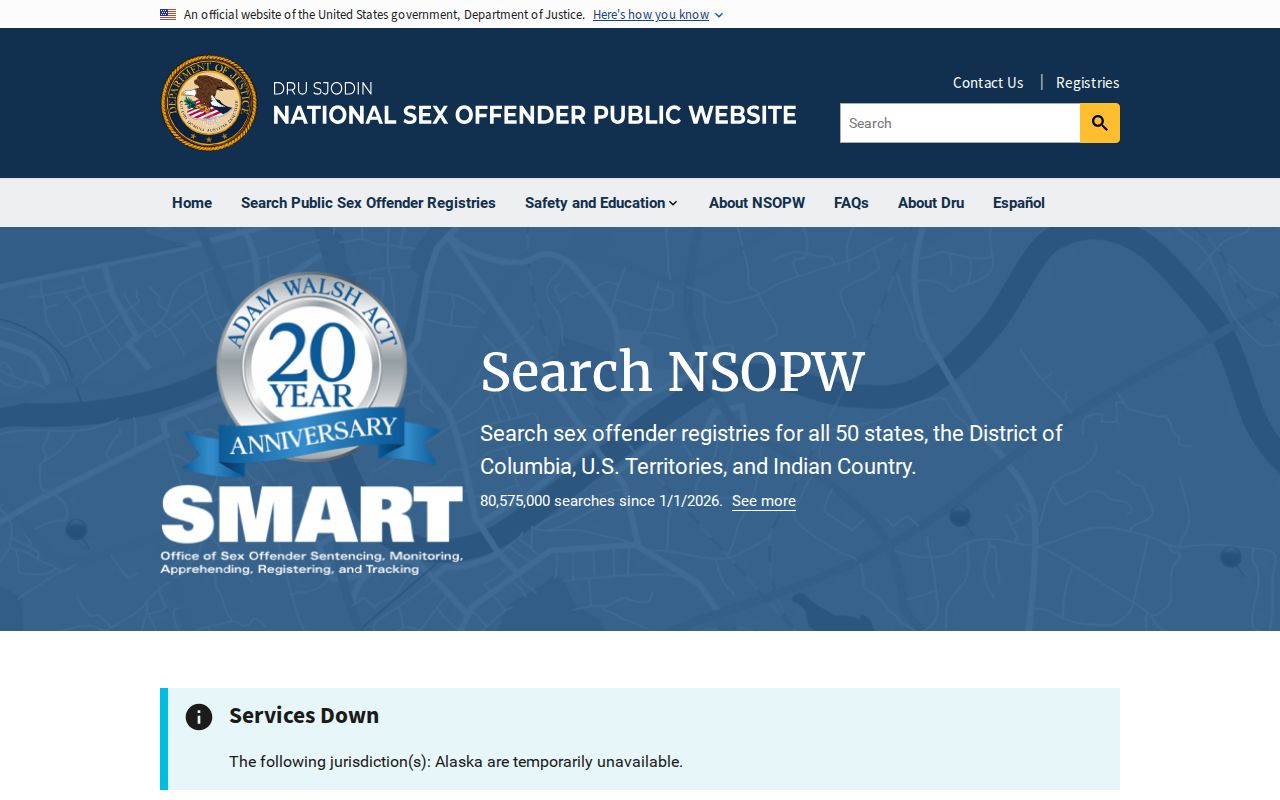
Read any national match through the linked state or territorial record, then use the listed agency contact to resolve a possible error or stale address.
Searching the Connecticut Sex Offender Registry
The Connecticut State Police Registry Unit, within DESPP, maintains the database. A search is free and begins after the visitor accepts the warning. Vendor controls can change, so use the labels shown on the live form. A careful Greenwich sex offender check follows four steps:
- Open the official disclaimer, read it, and accept the stated conditions of use.
- Enter a first and last name, or choose a location route using Greenwich, an address, ZIP code, and radius where offered.
- Review the list or map without assuming that a nearby point proves present location at that moment.
- Open the full profile and compare several identifiers before treating the result as a match.
| Field Label | Type | Required | Notes |
|---|---|---|---|
| Last Name | Text | No | Primary name-search route |
| First Name | Text | No | Narrows a surname match |
| Address | Text | No | Pairs with location and radius tools |
| City / ZIP | Text or select | No | Choose Greenwich for town-focused results |
| Radius / Map | Select and view | No | Live options may change |
When Greenwich Registry Search Finds Nothing
A blank result does not prove that no registration exists. Check spelling, aliases, city boundaries, and nearby ZIP codes. Greenwich mailing addresses and neighborhood names can lead a user to enter a label the live form does not recognize. Try the address route as well as the name route, and widen the lawful search area if the facts support it.
Registration is offense-based and governed by Connecticut law. Some old, excluded, sealed, or out-of-state matters will not appear as a current Greenwich public profile. The registry is not a general criminal history system. For a court outcome, use the Connecticut Judicial Branch case lookup. For an official Connecticut conviction record about yourself, use SPBI and CCHRS.
Note: Greenwich Alerts and Everbridge provide emergency notifications; they are not offender-registry search or address-change alert tools.
What a Registry Profile Shows
Profiles can contain many fields, but their presence varies. Read the status and jurisdiction along with the address. A profile is a statutory public record, not a live tracking feed and not a full biography. Connecticut may display the following categories:
| Name & Aliases | Legal display name and alternate names supplied to the registry. |
|---|---|
| Photo & Description | Photograph, sex, race, height, weight, hair, eyes, age or DOB, and distinguishing marks when supplied. |
| Registered Address | The reported residential address. It is not real-time location data. |
| Offense & Statute | Offense description, legal citation, conviction or adjudication date, and jurisdiction where displayed. |
| Registration Period | Start, end, or lifetime status when the public record provides it. |
| Status & Identifiers | Compliance notices, vehicles, victim category, or other identifiers may appear. |
Reporting Greenwich Registry Concerns
The state Sex Offender Registry Unit is the records authority. It is located at 1111 Country Club Road, Middletown, CT 06457, and publishes 860-685-8060 and SORU@ct.gov on official materials. Contact that unit to ask about a public profile, registration form, or apparent database error. Give the profile details needed to identify the record, but avoid circulating personal data elsewhere.
For a suspected Greenwich violation or immediate local safety concern, contact the Greenwich Police Department. Dispatch and the nonemergency officer desk use 203-622-8004; emergencies require 911. The Police Special Victims Section publishes 203-622-8030, but the department's contact directory does not make that section a separate public registry custodian.
Connecticut Registry Unit
1111 Country Club Road
Middletown, CT 06457
860-685-8060
Greenwich Police
11 Bruce Place
Greenwich, CT 06830
203-622-8004
Registration Requirements and Levels in Connecticut
Connecticut does not use a simple public Level 1, Level 2, and Level 3 risk ladder. Its scheme is offense-based. CGS §§54-250 through 54-261 define covered groups, reporting duties, disclosure, and penalties. Many covered offenses against minors and nonviolent sexual offenses carry a ten-year duty. Sexually violent offenses and repeat covered convictions can lead to lifetime registration.
| Connecticut Category | Typical Duration | Key Point |
|---|---|---|
| Covered offense against a minor | Often 10 years | The exact statute and case control. |
| Covered nonviolent sexual offense | Often 10 years | Do not infer duty from a generic federal tier. |
| Sexually violent or repeat covered offense | May be lifetime | Relief exists only where Connecticut law permits it. |
Greenwich Address Change Duties
Connecticut's change and confirmation materials ask for the registrant's name and date of birth, prior address, new street and unit, town, state, ZIP code, effective date, signature, and date. A post office box is not a substitute for the required street address. Under §§54-251 through 54-255, written notice is due within five days for address changes in the circumstances those statutes cover.
Failure to comply or knowingly supplying false information can be a class D felony. That consequence makes official reporting more useful than online speculation. Apparent noncompliance should go to the Registry Unit or Greenwich Police. A resident should not investigate a home, publish an accusation, or attempt to enforce registry rules personally.
Profile correction: Report a suspected stale or wrong Greenwich address to the agency. The public should not edit, annotate, or crowdsource registry data.
Registry Records Are Not Rap Sheets
A Greenwich registry result answers a narrow question: whether the state displays a current statutory registration profile matching the search. It does not list every arrest, every conviction, pending criminal cases, protective orders, or Connecticut DOC custody history. Those records come from different custodians and have different public-access rules.
Use the Judicial Branch Criminal/Motor Vehicle Case Look-up for public pending and conviction dockets. Use SPBI's CCHRS for an official Connecticut conviction-history product, especially when reviewing your own record. Use the DOC Inmate Information Search for current state custody. Keeping those channels separate prevents a registry entry from being treated as a complete account of a person's legal history.
The same separation matters for timing. Registry changes depend on the statutory reporting process and the information supplied to the Registry Unit. A court docket can change when a charge is amended or disposed, while a custody record can change after release or transfer. Comparing timestamps and agency roles is more reliable than assuming that every official system refreshes at once. When a Greenwich profile conflicts with another record, describe the conflict to the maintaining agency and ask it to confirm the current public entry.
Connecticut's registry also should not be read as a list of every person who has ever faced a sexual-offense allegation. Registration follows covered convictions, adjudications, and statutory duties. Conversely, a person can have a criminal court record that creates no public registration profile. For personal safety research, the registry answers the registration question. For case history, obtain the public docket and, when necessary, ask the clerk about the underlying file and current disposition.
Lawful Use and Community Notification
Registry information supports personal, family, neighborhood, and community awareness. It can help a reader plan safe routines and verify information through an official channel. It cannot establish where someone is at a given moment, and it should not be used to provoke contact. Connecticut places the misuse warning before the public search for a reason.
Greenwich Police may act on a report within its jurisdiction, while DESPP maintains the statewide record. National and state searches are useful layers, not invitations to circulate profiles on social media. Confirm the record with its originating agency when accuracy matters.
Use the information lawfully: CGS §54-258a warns that using registry information to injure, harass, or commit a criminal act can lead to prosecution. Never threaten, intimidate, discriminate against, or target a registrant or household.